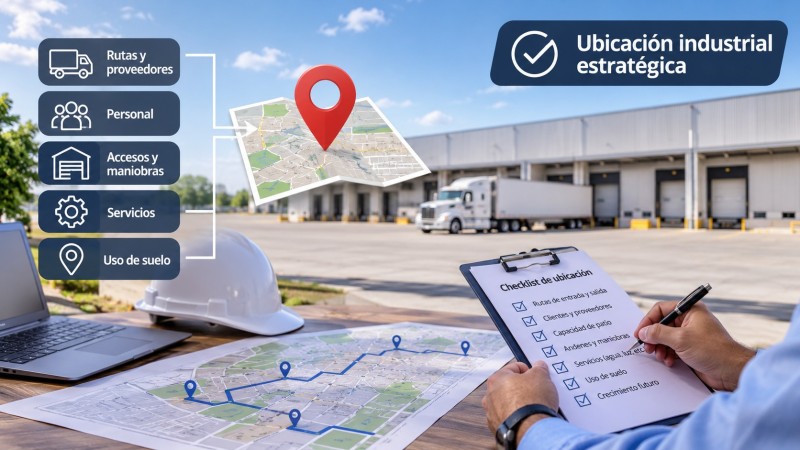
The best industrial location is not necessarily the one that appears closest on the map, but the one that makes your day-to-day operations viable. Compare locations based on your actual incoming and outgoing routes, customers, suppliers, workforce, vehicles, access, and the utilities that must be verified at each property.
Before visiting properties, prepare a route plan: where goods arrive from, where they are delivered, who works at the facility, and which vehicles need access. Record operating hours, trip frequency, yard requirements, tolerance for detours, and projected growth. Work with both a normal operating scenario and a high-demand scenario; you do not need false precision to begin narrowing down your options.
Our guide to Ciudad Industrial and the Mérida-Umán corridor provides local context. This matrix complements that article by identifying the evidence you should request for your specific operation, without assuming that one industrial area works equally well for every business.
| Operation | Location Priority | What to Verify |
|---|---|---|
| Regional storage and distribution | Consistent access routes to suppliers and customers. | Full route assessment, turning radius, fleet access, yard, loading docks, and utilities. |
| Urban last-mile delivery | Repeated access to delivery areas and efficient shift changes. | Traffic during actual operating hours, alternative access routes, parking, loading areas, and required land use. |
| Light manufacturing | Access to suppliers, technical staff, and utilities compatible with the production process. | Land-use classification, electricity, water, drainage, telecommunications, and waste management. |
| Distribution center (DC) or cross-docking | Continuous flow between receiving and dispatch operations. | Site layout, maneuvering requirements verified by a specialist, loading docks, access, and circulation. |
| Labor-intensive operations | Reliable commuting options for shift workers and transportation used by employees. | Arrival patterns, parking, pedestrian routes, public transportation, and alternative access options. |
The table is useful for screening potential properties; however, it does not replace a traffic study, an architectural project, or a technical assessment.
Visit each property during actual operating hours and record turning points, traffic queues, shared access roads, and visible restrictions. Request site plans and measurements. Confirm that the access routes described in the listing can legally accommodate your fleet. Being close to a major road does not guarantee that a semi-truck, delivery truck, or other vehicle can enter and exit as required.
Land use must be compatible with your business activity and proposed project, not just labeled as "industrial." The General Law of Human Settlements, Territorial Planning, and Urban Development connects zoning and authorizations with applicable development plans, as well as water, drainage, electricity, and mobility capacity. In Mérida, the Municipal Land Use portal requests information about current land use, proposed land use, and business activity. Bring a specific description of your intended operations to the relevant authorities and your professional advisors.
For utilities, request current supporting documentation and identify who is responsible for confirming availability and capacity. CFE distinguishes between procedures for low-voltage business electricity service and medium-voltage supply in its official service catalog. This does not prove the electrical capacity of a specific property, but it highlights the importance of matching your application to your actual power requirements. Apply the same approach to water, drainage, and telecommunications: request written confirmation of feasibility, connection points, conditions, and costs.
If you are comparing land with an existing industrial building, complement this matrix with our guide to reviewing industrial land before building a warehouse. To begin your search, visit our warehouse and industrial facility listings for sale in Mérida, but confirm the transaction type and details of each listing before using it as a comparable property.
Neither is better for every business. The right choice depends on your routes, vehicles, customers, suppliers, workforce, permitted land use, and verified utilities. Use the information in our article 160 as a starting point, then evaluate your actual routes.
No. Check the final stretch of the route, turning radius, restrictions, legal access, maneuvering yard, and internal circulation using the vehicles you actually intend to operate. If there are questions about maneuvering or road safety, request a specialized assessment.
Start by requesting the complete property listing, site plan, measurements, access information, utility documentation, and the land-use document or procedure applicable to your intended business activity. Then coordinate the review with a notary, the relevant authorities, and qualified specialists. A commercial listing does not replace these verifications.
Map your supplier, customer, and employee routes, define your fleet requirements, and request a comparison of warehouses, industrial facilities, or land. Explore our industrial properties for sale and contact Yucatán Properties with your comparison matrix to request property options with verifiable information.
Site Map
Newsletter


