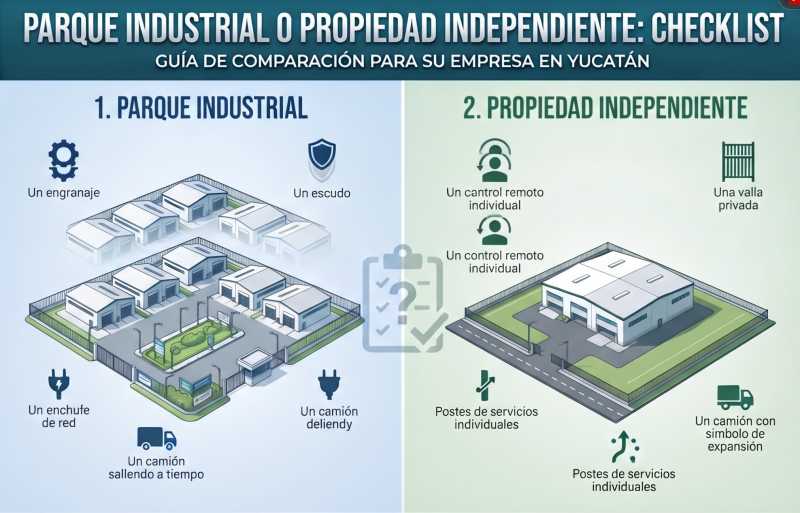
Choosing between an industrial park and a standalone property is not simply a matter of choosing between shared services and freedom. An industrial park may have regulations, management, and shared facilities; a standalone property may offer greater direct control, but it also comes with additional responsibilities. Compare the legal framework, obligations, and operational requirements your company needs in writing.
The first question is: What legal structure applies to the land and industrial building? Confirm whether it is a condominium regime, private development, co-ownership, association, or property without shared management. Request the deed, articles of incorporation, regulations, plans, and ownership participation percentage, if applicable.
If the development operates under a condominium ownership regime in Yucatán, the state law establishes private units, common areas, bylaws, and participation fees in the constitutive deed. Not every industrial park operates under this structure, so request the applicable documentation and professional legal review.
The NMX-R-046-SCFI-2015 standard is listed as current in the official catalog. Its declaration in the Official Gazette outlines specifications regarding legal provisions, infrastructure, urban development, services, and industrial park management. Use it as a framework for your questions, not as proof that every park provides each service.
Ask who makes decisions regarding access, roads, operating hours, building facades, parking, and construction. Who manages the development? How are changes approved and maintenance issues reported? Request the regulations, meeting minutes, budget, and rules governing the sale, lease, transfer, or modification of the unit.
For a standalone property, ask who controls access roads, easements, street lighting, drainage, boundaries, and infrastructure outside the lot. Having less shared management does not eliminate permits, service providers, repairs, or security responsibilities. Define which modifications you can make and which require authorization.
Do not assume that an industrial park automatically includes security, water, drainage, electricity, internet, waste collection, access control, or fire protection systems. Ask:
What services are available, who operates them, and what portion is allocated to your unit?
Is there a meter, service contract, documented capacity, and interruption protocol?
Does the maintenance fee cover roads, common areas, lighting, security, or only certain services?
Who pays for connections, consumption, repairs, upgrades, and equipment?
Request contracts, receipts, plans, maintenance logs, and service-level agreements. For a standalone property, request utility statements and service feasibility confirmation from the provider; a visible connection does not guarantee sufficient capacity.
The Municipality of Mérida states that a Municipal Operating License requires a Land Use License for Business Operations beforehand. Confirm that the permitted business activity, address, and application requirements match your intended operation.
Compare the purchase price and operating expenses. For an industrial park, record regular maintenance fees, reserve funds, special assessments, management fees, security, maintenance, utilities, access charges, and future improvement costs. Ask about the calculation method, payment dates, outstanding balances, late-payment consequences, and who authorizes extraordinary expenses.
For a standalone property, there may be no industrial park maintenance fee, but your company may have to cover security, access roads, drainage, waste disposal, repairs, and permits directly. Use the same checklist for both alternatives. If a cost is not documented, mark it as pending rather than assuming it represents a saving.
Before making an offer, answer these questions with supporting documentation:
Can your vehicles enter, wait, load, and exit during permitted operating hours?
Do the regulations allow your type of storage, distribution, light manufacturing, or equipment?
Can you install racking systems, machinery, signage, roofing, or access controls?
What happens during maintenance of roads, utilities, or common areas?
Does the property allow expansion, subdivision, transfer, or a change of operator?
To organize your logistics comparison, consult our guide to Ciudad Industrial and the Mérida–Umán corridor.
An industrial park may be a good fit if its regulations, confirmed services, and fees support your operations. A standalone property may be more suitable if you need greater control and can take responsibility for the infrastructure. Neither option is inherently better.
No. Verify each service through the regulations, contracts, budget, and evidence of actual operation. Ask what is excluded and who is responsible.
Not necessarily. It may eliminate shared maintenance fees, but your company may become responsible for security, access, maintenance, and other operational expenses. Compare the total annual cost.
Do not assume so. Review the ownership structure, regulations, municipal permits, and technical authorizations before purchasing or planning any modifications.
Explore our industrial warehouses and commercial buildings for sale in Mérida. Confirm the availability, price, and validity of each listing, and share your checklist with Yucatan Properties to request options based on your business activity, logistics routes, services, and desired level of control.
Site Map
Newsletter