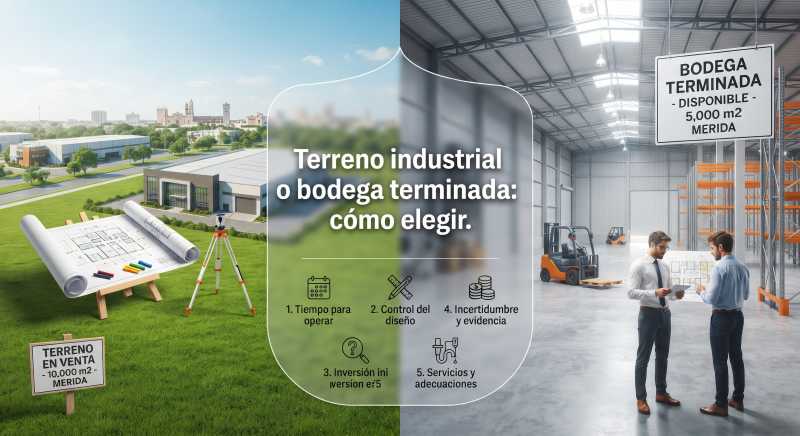
If you are deciding between purchasing industrial land and building a warehouse or acquiring a finished warehouse, the question is not which option costs less per square meter. Compare which option can accommodate your operations within your required timeframe, how much control you need over the design, what initial investment you can afford, and what uncertainties you are willing to manage. A ready-built warehouse may allow you to start operations sooner, while purchasing land gives you the opportunity to develop a property tailored to your specific needs. Neither option is automatically better.
When you purchase industrial land, you are acquiring a location, a plot of land, and the opportunity to design a facility from scratch. You will still need to turn the project into architectural plans, permits, construction, installations, testing, and operational readiness.
With a finished warehouse, you can inspect the existing structure and adapt an established facility. This may reduce the number of design and construction stages, but it does not necessarily mean the property is ready for your operations. Compare the layout, ceiling height, flooring, access points, loading yard, offices, electricity, water, drainage, and connectivity against your company's actual operational requirements.
Ask what needs to happen between signing the purchase agreement and the first day of operations. For industrial land, consider studies, design, permits, construction, equipment installation, and testing. For a finished warehouse, separate required improvements, utility connections, systems, and outstanding repairs.
Request a timeline with specific milestones. Do not treat an estimated commercial delivery date as a guaranteed operational start date.
Industrial land can offer greater freedom to organize receiving areas, storage, production, offices, parking, loading yards, and future expansions. However, this flexibility is only valuable if the property can accommodate the proposed project. The land's shape, access points, restrictions, permitted use, and available utilities must all be verified.
Our article on what to review before building an industrial warehouse on industrial land provides additional context. The key question here is whether you are prepared to take responsibility for the entire development process.
A finished warehouse offers less control over the existing structure but allows you to evaluate its layout. If demolition, structural reinforcement, or modifications to existing installations are necessary, include those costs before submitting an offer.
Do not compare the purchase price alone.
For industrial land, account for acquisition, project design, permits, construction, utility connections, supervision, equipment, and a contingency reserve for unexpected changes.
For a finished warehouse, account for acquisition, closing costs, renovations, equipment not included in the sale, deferred maintenance, and any outstanding compliance or documentation requirements.
Request comparable budgets and identify any costs that remain subject to confirmation by the relevant authorities.
Industrial land involves uncertainty regarding what has not yet been developed: design, soil conditions, permits, contractors, and construction.
A finished warehouse involves uncertainty regarding the existing structure: roof condition, installations, drainage, documentation, previous expansions, and compatibility with your operations.
In either case, make your purchase offer subject to the appropriate legal, physical, and technical inspections.
In Mérida, the municipal platform distinguishes between Land Use Feasibility and other regulatory approvals.
Check with the City Council regarding the applicable land use requirements and construction permits for the property and any proposed construction work.
An existing warehouse does not automatically authorize every type of business activity or future expansion.
Request specific documentation confirming the availability and conditions of electricity, water, drainage, telecommunications, and stormwater management.
For additional electrical loads or new equipment, CFE provides service applications and procedures for modifications resulting from increased electrical demand. Ask a qualified specialist to assess how these requirements apply to the specific property.
Also verify water supply and wastewater service availability and conditions with the appropriate provider.
Consider purchasing industrial land when your operations require a specialized layout, phased development, or installations that available warehouses cannot accommodate.
Consider purchasing a finished warehouse when its existing design is compatible with your operations and getting started sooner is more important than having complete customization.
If both options seem viable, compare them using the same operational requirements, target start date, and level of verified information.
No. Although it may eliminate some design and construction stages, renovations, permits, utility connections, equipment, documentation, and repairs can affect the timeline. Confirm every milestone for the specific property.
It provides greater control over the design, but it also involves construction and coordination risks. Have specialists verify the property, permitted use, utilities, budget, responsibilities, and construction requirements.
Use the same operational brief for both options. Include your business activity, usable floor area, access points, equipment, personnel, utilities, expansion plans, and target start date.
Record which details have been verified, which require quotations, and which depend on regulatory approval.
To explore available purchase options, browse our industrial warehouses and buildings for sale in Mérida.
You can also send your business activity, required floor area, logistics routes, utility requirements, and target start date through our Contact page.
This way, the comparison starts with your business needs rather than just the information presented in a property listing.
More...
More...
Site Map
Newsletter


